
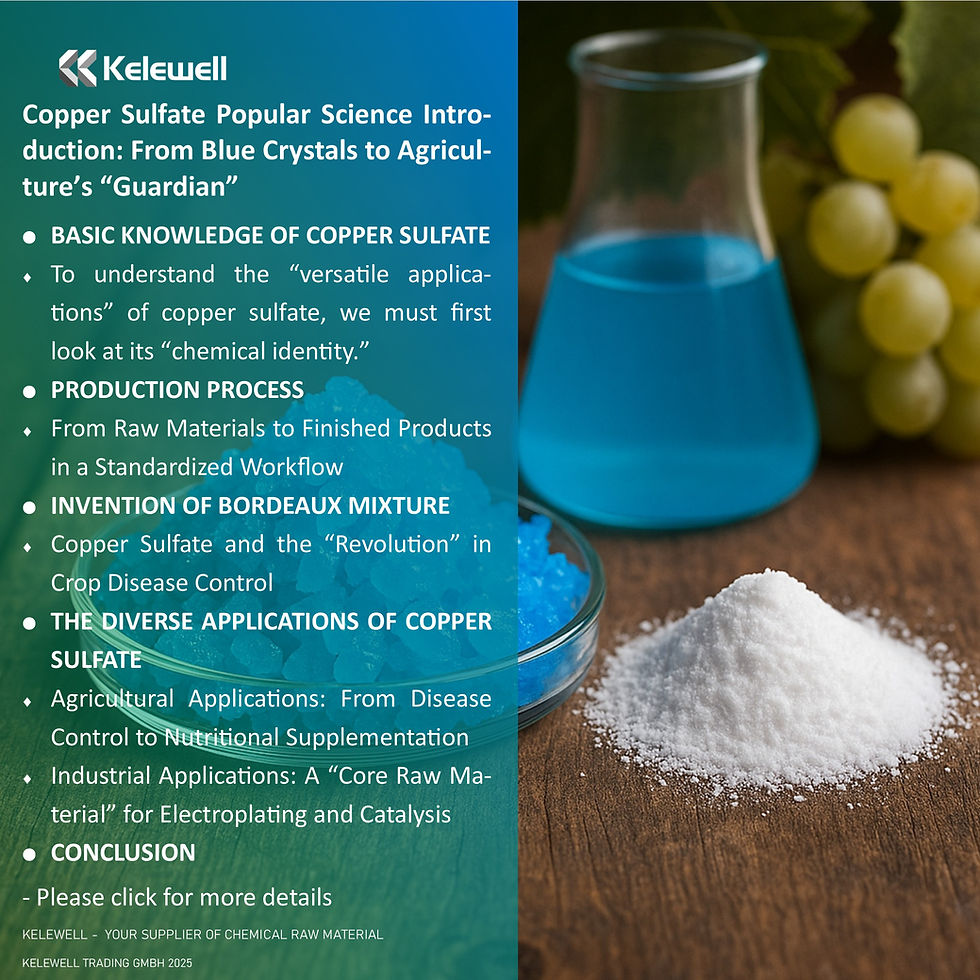
Copper Sulfate Popular Science Introduction: From Blue Crystals to Agriculture’s “Guardian” – Unlocking the Versatile Value of Copper Compounds

When people think of “blue crystals,” many immediately recall the “blue vitriol” in laboratories or the “Bordeaux mixture” used in agriculture to control plant diseases. These familiar scenarios highlight the diverse value of copper sulfate (CuSO₄).
As a common copper salt, it serves as a desiccant in its anhydrous form and a fungicidal agent in its crystalline state. Moreover, thanks to the invention of Bordeaux mixture, it has become an indispensable “disease-control tool” in agricultural history.
This article explores copper sulfate from multiple perspectives—its chemical nature, production processes, and hydrated forms—while tracing the legendary history of Bordeaux mixture to provide a comprehensive understanding of this remarkable blue compound.
I. Basic Knowledge of Copper Sulfate: Chemical Nature and Physical Properties
To understand the “versatile applications” of copper sulfate, we must first look at its “chemical identity.” Copper sulfate is a salt composed of copper ions (Cu²⁺) and sulfate ions (SO₄²⁻), with the chemical formula CuSO₄. Its key characteristics vary significantly depending on whether it contains water.
(1) Core Chemical Properties
Valence and Stability: In copper sulfate, copper exists in the +2 oxidation state (a stable valence). Therefore, copper sulfate is relatively stable and does not easily decompose at room temperature. At high temperatures (above 650 °C), however, it decomposes into copper oxide (CuO), sulfur dioxide (SO₂), and other substances, losing its original functions.
Solubility and Acidity: Copper sulfate is easily soluble in water (solubility at 20 °C is about 20.7 g/100 mL). Its aqueous solution is weakly acidic (pH ≈ 3.8–4.5). This property allows it to react with alkaline substances to form precipitates (e.g., in the preparation of Bordeaux mixture) and to release copper ions in solution, exerting fungicidal effects.
(2) Physical Differences Between Two Main Forms
The “morphological diversity” of copper sulfate is the key to its wide applications. The two most common forms are anhydrous copper sulfate and copper sulfate pentahydrate, which differ greatly in appearance and properties:
Form | Appearance Characteristics | Density (20 °C) | Hygroscopicity / Dehydration Properties | Key Identification Point |
Anhydrous CuSO₄ | White or grayish-white powder, odorless | 3.603 g/cm³ | Strongly hygroscopic, rapidly turns blue when in contact with water | Color change on hydration (white → blue) |
CuSO₄·5H₂O (Pentahydrate) | Blue crystals (orthorhombic), odorless | 2.284 g/cm³ | Stable at room temperature, easily loses water when heated | Natural blue color, commonly known as “blue vitriol” or “chalcanthite” |
II. Production Process of Copper Sulfate: From Raw Materials to Two Distinct Forms
The industrial production of copper sulfate follows the core principle of “copper source oxidation + sulfuric acid dissolution.” Depending on the raw materials used, there are two mainstream processes. The final product can be transformed into either the anhydrous or crystalline form through dehydration / hydration.
(1) Mainstream Production Processes: Two Core Routes
1. Oxidation–Acid Dissolution of Scrap Copper (Industrial Mainstream)
This is the most economical method, using copper scrap or slag as raw materials. The steps are as follows:
Oxidation Pretreatment: Scrap copper is fed into a reverberatory furnace and oxidized at 600–700 °C in the presence of air, producing copper oxide (CuO). If impurities such as iron or zinc are present, they can be removed at high temperatures, as iron oxides form slag and separate.
Sulfuric Acid Dissolution: After cooling, the copper oxide is reacted with dilute sulfuric acid (30–40%) at 80–90 °C under stirring, generating copper sulfate solution:
CuO + H₂SO₄ → CuSO₄ + H₂O
Purification and Crystallization: The insoluble impurities are filtered out. The filtrate is transferred to an evaporative crystallizer, concentrated at 60–70 °C, and then cooled to 20–25 °C, where blue crystals of copper sulfate pentahydrate (CuSO₄·5H₂O) precipitate. For the anhydrous form, the pentahydrate is further heated to above 250 °C, completely removing the crystalline water to yield a white powder.
2. Recovery from By-products of Electrolytic Copper (High-Purity Demand)
This route is used to produce electronic- and pharmaceutical-grade copper sulfate with purity ≥ 99.99%:
Copper-containing electrolytes from electrolytic copper production are treated with ion exchange resins to remove heavy metal impurities such as iron, nickel, and lead, followed by evaporation and crystallization to obtain high-purity copper sulfate pentahydrate.
Advantages: Very high purity and low impurity content, making it suitable for pharmaceuticals, electronics, and electroplating industries with strict purity requirements. However, the cost is 30–50% higher than the scrap-copper method.
(2) Hydrate “Hydration–Dehydration” Cycle: Correlation Between Forms and Uses
The transformation of copper sulfate hydrates is a reversible process. At different temperatures, varying amounts of crystalline water are lost, leading to different forms and uses, as shown below:
Hydrate Type | Chemical Formula | Formation Condition | Appearance / Color | Main Application |
Copper Sulfate Pentahydrate | CuSO₄·5H₂O | Crystallization from aqueous solution at room temperature | Blue crystals | Agricultural fungicide, feed additive, electroplating raw material |
Copper Sulfate Trihydrate | CuSO₄·3H₂O | Heating CuSO₄·5H₂O to about 102 °C | Blue-green crystals | Low stability, difficult to preserve at ambient conditions; usually a transitional product during heating |
Copper Sulfate Monohydrate | CuSO₄·H₂O | Further heating to about 113 °C | White powder (slightly bluish) | Industrial desiccant (less efficient than anhydrous CuSO₄) |
Anhydrous Copper Sulfate | CuSO₄ | Stepwise dehydration, fully converted above ~250 °C | White powder | Moisture indicator (turns blue upon hydration), catalyst in organic synthesis |
Key Characteristics:
The hygroscopicity of anhydrous copper sulfate makes it a widely used moisture indicator in laboratories and industry. For example, to check whether alcohol or ether contains water, a small amount of anhydrous CuSO₄ is added—if it turns blue, moisture is present. In contrast, the stability of copper sulfate pentahydrate makes it the “mainstream form” in agriculture and electroplating, as it does not readily dehydrate at room temperature, making it convenient for storage and use.
III. The Invention of Bordeaux Mixture: Copper Sulfate and the “Revolution” in Crop Disease Control
When discussing the applications of copper sulfate, one cannot ignore the most classic fungicide in agricultural history—Bordeaux mixture. Its invention was not the result of deliberate research, but rather an accidental discovery born out of a grapevine disease crisis, combining both chance and ingenuity.
(1) The 19th-Century Grapevine Crisis: The Birth of Bordeaux Mixture
In 1882, the Bordeaux region of France—a world-renowned wine-producing area—was struck by a severe outbreak of downy mildew in grapevines. This fungal disease caused yellow spots on leaves and rotting of fruits, resulting in yield losses of over 50% that year and devastating economic damage to growers. At the time, scientists experimented with multiple methods (such as sulfur fumigation and lime water sprays), but none effectively curbed the spread of the disease.
(2) Millardet’s “Accidental Discovery”: From “Deterrence” to “Disease Control”
Pierre Millardet, a professor of botany at the University of Bordeaux, observed that grapevines along public roads—where growers had applied a “special treatment”—showed little or no infection.
The reason: grape growers often sprayed a mixture of copper sulfate solution (blue) and lime water (white) on vines near roads to deter passersby from stealing grapes. The mixture produced a cloudy sky-blue coating that was visually unappealing (thus discouraging theft) and had a pungent odor. Unexpectedly, it also protected the vines against downy mildew.
Millardet realized that this mixture likely had fungicidal properties. He conducted laboratory experiments and found:
The optimal formula was 1 part copper sulfate + 1 part quicklime + 100 parts water, which controlled downy mildew effectively with minimal leaf burn.
The mode of action: copper ions (Cu²⁺) were slowly released, penetrating fungal cell walls and disrupting their enzymatic systems, thereby inhibiting reproduction. Meanwhile, the alkaline environment from lime extended the release time of copper ions, prolonging protection.
In 1885, Millardet officially published his findings and named the mixture “Bordeaux Mixture.” It quickly spread across vineyards in France and Europe, not only controlling downy mildew but also proving effective against other diseases such as apple rot and potato late blight, making it the most widely used fungicide of its time.
(3) The “Secret of Longevity”: Unique Advantages of Copper Sulfate
Bordeaux mixture has endured for more than 140 years, thanks to the distinctive properties of copper sulfate:
Broad-Spectrum Fungicidal Action: Effective against fungi (downy mildew, powdery mildew) and bacteria (citrus canker), applicable to over 200 crops including grapes, apples, tomatoes, and potatoes.
Low Risk of Resistance Development: Copper ions disrupt the basic enzymatic systems of microorganisms, making it difficult for them to develop resistance through genetic mutations—an advantage over many modern fungicides.
Low Cost and Easy Preparation: Copper sulfate and lime are inexpensive and widely available. Farmers can mix them in simple proportions without specialized equipment, making Bordeaux mixture especially suitable for large-scale agricultural use.
⚠️ Precautions:
Despite its benefits, Bordeaux mixture also has limitations. It is a protective fungicide—it must be applied before infection to form a protective coating. Its alkaline nature means it should not be mixed with acidic pesticides (e.g., trifloxystrobin), as acidity accelerates copper ion release, increasing phytotoxicity and reducing efficacy.
Moreover, the ratio should be adjusted depending on crop type and disease, and excessive use may lead to copper accumulation in soil, affecting root development. Therefore, applications should be limited to no more than three times per year.
IV. The Diverse Applications of Copper Sulfate: More Than Just an “All-Rounder” in Agriculture
Beyond its use in Bordeaux mixture for agriculture, copper sulfate in its different forms also plays important roles in industry, medicine, and laboratories, extending across many aspects of daily life.
(1) Agricultural Applications: From Disease Control to Nutritional Supplementation
Fungicide: Most fungi can be killed with very low concentrations of copper sulfate. In addition to Bordeaux mixture, copper sulfate pentahydrate can also be diluted (1:1000 solution) and sprayed to control citrus canker and tomato early blight. It can also be used for rice seed soaking (0.1% solution for 24 hours) to prevent seedling blight. Moreover, copper sulfate can be applied to control Escherichia coli. Copper sulfate is also used as an algaecide—its mechanism involves copper ions penetrating algal cell walls and replacing the magnesium in chlorophyll, thereby disabling photosynthesis and leading to cell death.
Feed Additive: Copper is an essential trace element for animal growth (promoting hemoglobin synthesis and enhancing immunity). Adding 0.02–0.05% copper sulfate pentahydrate to feed (strictly following national regulations) can prevent “copper-deficiency anemia” in pigs and poultry, improving growth performance and survival rates.
(2) Industrial Applications: A “Core Raw Material” for Electroplating and Catalysis
Electroplating Industry: Copper sulfate pentahydrate is the main electrolyte in “copper electroplating.” When dissolved in plating baths and subjected to an electric current, copper ions deposit onto the surface of metal workpieces (such as iron nails or zinc alloys), forming a uniform copper coating that provides rust resistance and aesthetic appeal (e.g., copper-plated hardware).
Coating Industry: Used in the preparation of copper oleate, which serves as a toxic agent in antifouling paints for ship hulls.
Dye Industry: Employed in the production of copper-containing monoazo dyes such as reactive brilliant blue, reactive violet, and phthalocyanine blue as copper complexing agents.
Water Treatment: Anhydrous copper sulfate can be added to industrial circulating water (0.5–1 mg/L) to control algae. Copper ions inhibit chlorophyll synthesis in algae, preventing clogging of pipelines. It also reacts with sulfides in water to form copper sulfide precipitates, removing unpleasant odors.
Organic Synthesis: Anhydrous copper sulfate is used as a catalyst to accelerate esterification reactions (e.g., synthesis of ethyl acetate).
(3) Medicine and Laboratory: Precision Detection and Auxiliary Treatment
Medical Applications: Low-concentration copper sulfate solutions (0.5–1%) have historically been used to assist in treating skin fungal infections (e.g., athlete’s foot), as copper ions inhibit fungal growth. However, due to its toxicity, copper sulfate should never be ingested or applied to broken skin, and in modern medicine it has largely been replaced by safer antifungal drugs.
Laboratory Applications: Anhydrous copper sulfate is a standard moisture indicator. For example, when testing whether gases contain water, they are passed through a drying tube filled with anhydrous copper sulfate; if the powder turns blue, moisture is present. In addition, it is used to prepare Fehling’s solution (for detecting reducing sugars) and in the biuret test for proteins, where copper forms a purple complex with proteins. It is thus a common reagent in biochemical laboratories.
V. Safety and Storage of Copper Sulfate: Beware of Toxicity and Use Scientifically
Although copper sulfate has wide applications, it is a heavy metal salt. It contains copper ions (excessive intake can cause copper poisoning), has an acidic taste with slight bitterness, and is toxic. If ingested accidentally, immediate treatment is necessary—consume or administer protein-rich foods such as milk, egg whites, or beef, or use calcium disodium EDTA as an antidote. Therefore, safe handling and storage are essential:
Operational Protection: When preparing Bordeaux mixture or copper sulfate solutions, wear rubber gloves and protective goggles. Avoid skin contact, as it may cause dryness or peeling. If it accidentally splashes into the eyes, rinse thoroughly with large amounts of clean water for 15 minutes and seek medical attention.
Storage Requirements: Copper sulfate pentahydrate should be stored sealed in a dry, cool place to prevent moisture (while it is not strongly hygroscopic, it can cake when damp). Anhydrous copper sulfate must be stored airtight to avoid absorbing atmospheric moisture and losing effectiveness. Both forms should be kept away from food and out of children’s reach, with packaging clearly labeled “Toxic Substance.”
Environmental Safety: After agricultural spraying, leftover copper sulfate solution must not be discharged directly into rivers or soil. The main hazard lies in the dissociated copper ions (Cu²⁺)—as heavy metal ions, they cannot be degraded naturally and tend to accumulate through the water/soil → organisms → food chain pathway, posing long-term, multidimensional risks to ecosystems and human health. Waste solution must be neutralized (by adding lime water to precipitate copper hydroxide) before disposal, to prevent copper ion pollution of soil and water.
VI. Conclusion: Copper Sulfate — From Blue Crystals to a “Model Compound” of Versatile Value
From a moisture indicator in laboratories, to a guardian against plant diseases in agriculture, and even as a core raw material in industrial electroplating, copper sulfate has become a true “model compound” linking chemistry with everyday life, thanks to its diverse forms and wide range of applications.
The invention of Bordeaux mixture further illustrates how scientific breakthroughs often arise from keen observation of accidental phenomena—a grapevine crisis led to the birth of a classic fungicide and cemented copper sulfate’s value in the history of agriculture.
Today, with the growing emphasis on environmental protection, the applications of copper sulfate are shifting toward precision use—such as controlled dosage to reduce soil accumulation and the development of low-toxicity copper formulations. Nevertheless, it remains an indispensable compound in agriculture and industry.
Understanding the properties and applications of copper sulfate not only enables us to use it more safely and effectively, but also allows us to appreciate the immense power of chemical substances in improving life and driving industrial progress.


Comments