
Phosphorus Management in Drip Fertigation Systems
- Camille W.

- Feb 4
- 5 min read
I. Forms and Availability of Phosphorus in Soil
Soil phosphorus can be categorized into two major classes based on its chemical properties: organic phosphorus and inorganic phosphorus. The vast majority exists in forms not readily available to plants, such as insoluble inorganic phosphates bound to iron, aluminum, and calcium, or as organic phosphorus compounds (e.g., phytates, phospholipids).
Plants primarily absorb orthophosphate ions (H₂PO₄⁻ or HPO₄²⁻) from the soil solution. Phosphorus that can be directly or indirectly utilized by plants is collectively termed available phosphorus (also known as readily available phosphorus). In agronomic practice, available phosphorus typically refers to the fraction extractable by chemical reagents (e.g., Olsen's method, Bray-1 method) or the fraction capable of isotopic exchange with the radioactive isotope ³²P. However, chemical extraction methods only measure a small portion of the phosphorus actually available to plants. Therefore, assessing available phosphorus requires comprehensive consideration of soil properties and environmental conditions.
II. Mobility of Phosphorus in Soil and Influencing Factors in Drip Fertigation
The mobility of phosphorus in soil is extremely low, with a typical diffusion radius of only 3–4 cm. This is primarily attributed to strong adsorption and fixation by soil components: in acidic soils, phosphorus readily forms insoluble precipitates with Fe³⁺ and Al³⁺; under alkaline conditions, it tends to combine with Ca²⁺ to form insoluble calcium phosphates; solubility is relatively higher in neutral soils.
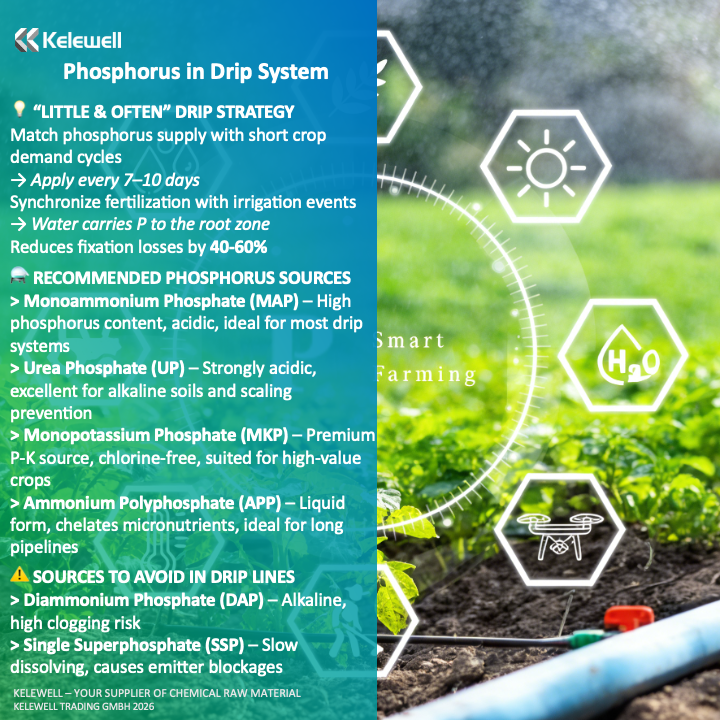
In conventional fertilization, phosphorus fertilizers are often applied once as a basal dose. The time lag between application and peak crop phosphorus uptake leads to significant fixation by the soil, reducing availability. Drip fertigation employs a "little and often" strategy, dynamically matching phosphorus supply with crop demand. Each application only needs to meet 7–10 days of growth requirements, thereby significantly reducing fixation losses.
Under drip irrigation, phosphorus mobility is influenced by the following key factors:
Influencing Factor | Mechanism and Effect |
Irrigation Water Volume | Adequate water increases the diffusion range and intensity of phosphorus; water deficit or insufficient irrigation significantly reduces phosphorus mobility. |
Irrigation Duration | With the same fertilizer dose, longer irrigation durations promote deeper vertical movement of phosphorus; irrigation frequency has no significant effect on phosphorus movement. |
Soil Texture | Phosphorus infiltration depth follows: sandy loam > loam > clay. Soils with high clay content exhibit stronger phosphorus adsorption/fixation and lower mobility. |
Phosphorus Fertilizer Form | Highly water-soluble sources (e.g., monoammonium phosphate, ammonium polyphosphate) show better mobility in drip systems; partially precipitated forms (e.g., single superphosphate) are not suitable for application through drip systems. |
III. Types and Characteristics of Phosphorus Fertilizers Suitable for Fertigation
The primary form of phosphorus absorbed by crops is H₂PO₄⁻ (optimal pH range 6.0–7.5). Commonly used water-soluble phosphorus fertilizers in drip systems include:
Fertilizer Type | Formula / Nutrient Content | Water Solubility (20–25°C) | pH (Solution) | Key Characteristics and Application Scenarios |
Monoammonium Phosphate (MAP) | NH₄H₂PO₄ (N 11–12%, P₂O₅ 61%) | 37.4 g/100g water | Acidic (~4–5) | – N-P binary fertilizer; H₂PO₄⁻ form is easily absorbed.– In neutral soils, ammonium is readily adsorbed, enhancing phosphorus mobility.– For drip irrigation, use industrial-grade products with total nutrients ≥72% and water-insoluble matter ≤0.1%. |
Diammonium Phosphate (DAP) | (NH₄)₂HPO₄ (N 18%, P₂O₅ 46%) | 41 g/100g water | Weakly Alkaline (~8.0) | – Solution alkalinity may exacerbate soil pH increase.– Market products can be adulterated (e.g., MAP mixed with other N sources sold as DAP).– Suitable for basal application; use cautiously in drip irrigation due to precipitation and clogging risks. |
Urea Phosphate (UP) | CO(NH₂)₂·H₃PO₄ (N 17.7%, P₂O₅ 44.9%) | Highly Soluble | Strongly Acidic (1.89) | – Acidic source helps lower root zone pH and activates trace elements.– Reduces emitter scaling, prolonging system lifespan.– Suitable for saline-alkali soils or high pH soil remediation. |
Monopotassium Phosphate (MKP) | KH₂PO₄ (P₂O₅ 52%, K₂O 34%) | Highly Soluble | Acidic (4–5) | – High-concentration P-K binary fertilizer, chlorine-free.– Higher cost; often used for foliar spray or critical growth stage drip fertigation.– Suitable for chloride-sensitive crops or those requiring high potassium. |
Ammonium Polyphosphate (APP) | (NH₄)ₙ₊₂PₙO₃ₙ₊₁ | Highly Soluble (often liquid) | Neutral – Slightly Acidic | – Has chelating properties, reduces soil fixation, improves micronutrient availability.– Good fluidity, low precipitation risk, suitable for long-distance pipelines.– Must hydrolyze to orthophosphates in soil before plant uptake. |
Note: Single Superphosphate (SSP), although containing some water-soluble P, dissolves slowly, contains impurities, and easily clogs emitters; it is not recommended for drip irrigation systems.
IV. Comparison of Phosphorus Fertilizer Selection and Application Strategies
1. MAP vs. DAP
P Content & Availability: MAP has higher phosphorus content, and its acidic nature helps maintain phosphorus solubility in alkaline soils.
Compatibility: Soils in regions like Xinjiang (Northern China) are often alkaline, making MAP's acidity more favorable for activating soil phosphorus.
Product Quality: Industrial-grade MAP (water-insoluble matter ≤0.1%) typically has higher purity than DAP (first-grade requires ≥95% active ingredient), making it more suitable for drip systems.
Market Standardization: The DAP market has more product variability; be wary of products adulterated with inferior MAP.
2. MAP vs. UP
pH Adjustment: UP's strong acidity helps lower root zone pH, improving phosphorus availability in alkaline soils.
Additional Functions: UP can activate soil calcium, magnesium, and other secondary/trace elements, reducing ammonia volatilization loss.
Nutrient Content: MAP has higher phosphorus content. Choice depends on soil pH and crop requirements.
3. MAP vs. MKP
Nutrient Composition: MAP supplies N-P, MKP supplies P-K. Selection depends on crop stage nutrient demands.
Cost-Effectiveness: Calculated per unit of phosphorus nutrient, MAP is significantly less expensive than MKP.
V. Phosphorus Fertilizer Application Schemes in Fertigation Systems
System Type | Recommended Fertilizer Combinations & Methods | Precautions |
Drip Irrigation | – Primary: MAP (drip) + UP (alternating or mixed).– Basal Application Support: DAP or SSP (pre-sowing).– Supplement: APP (for long pipelines or micronutrient activation). | – Avoid sole reliance on basal P application; prioritize drip fertigation.– Do not use DAP or SSP directly in drip lines.– Perform regular acid flushing to prevent scaling/precipitation. |
Sprinkler/Micro-sprinkler | – Foliar/Top-dressing: MKP (spray).– Basal Application: SSP or DAP. | – MKP is suitable for nutritional boosting during critical growth stages.– Basal P application should be quantitatively based on soil testing. |
General Recommendations | – Prioritize high water-solubility, low-impurity industrial-grade P fertilizers.– In alkaline soil regions, combine UP or APP for pH adjustment.– Dynamically adjust P rate and frequency based on crop demand patterns (e.g., root promotion in early stages, fruit/pod development in flowering). | – Regularly monitor soil pH and available P levels to avoid over-fertilization.– Be aware of P antagonism with Zn, Fe, etc.; apply chelated micronutrients if necessary. |
Conclusion
In drip fertigation systems, Monoammonium Phosphate (MAP) is the mainstream phosphorus source due to its high P content, acidic properties, and lower cost. Urea Phosphate (UP) is suitable for scenarios requiring pH adjustment or system scaling prevention. Monopotassium Phosphate (MKP) is often used for supplemental feeding in high-value crops during critical periods. Ammonium Polyphosphate (APP) is suitable for long pipeline networks or systems requiring micronutrient integration. The direct use of fertilizers prone to precipitation (e.g., DAP, SSP) in drip irrigation should be avoided. Adopting a "little and often, water-fertilizer synergy" strategy can significantly improve phosphorus use efficiency and reduce fixation losses.


Comments